What Are the Most Common Methods for Electronic Assembly Cleaning?

Modern SMT assemblies require highly effective cleaning technologies to remove flux residues and ionic contamination. Learn how spray-in-air, spray under immersion, and ultrasonic cleaning methods compare in electronics manufacturing.

Why Cleaning Electronic Assemblies Is Essential

Cleaning electronic assemblies is an important process step in modern electronics manufacturing. The primary goal is to remove ionic contamination, soldering flux residues, and other process impurities from the surfaces of populated printed circuit boards (PCBs), especially between conductors and contact points.

Most soldering flux residues are not water-soluble, particularly in modern no-clean soldering processes. Therefore, specialized cleaning chemistries and cleaning methods are required to ensure high insulation resistance, long-term reliability, and protection against electrochemical corrosion.

The Evolution of Electronic Assembly Cleaning

In earlier electronics manufacturing processes, assemblies were relatively simple and mainly based on through-hole technology. Fluxes contained large amounts of rosin, which could be easily removed with isopropyl alcohol (IPA) and manual cleaning methods such as brushes.

As electronics became more complex and soldering chemistries evolved, cleaning requirements increased significantly. Flux additives improved soldering performance but also reduced solubility. For many years, chlorinated hydrocarbons provided excellent cleaning performance. However, these substances were later banned under the Montreal Protocol due to their harmful effects on the ozone layer.

This marked the beginning of modern environmentally conscious cleaning technologies that balance cleaning efficiency, process safety, and sustainability.

Why Modern SMT Assemblies Are More Difficult to Clean

The introduction of Surface Mount Technology (SMT) dramatically changed cleaning requirements in electronics manufacturing. Modern components are positioned extremely close to the substrate, creating very narrow gaps beneath resistors, capacitors, bottom-terminated components, and advanced packages.

Flux residues can become trapped underneath these components, where capillary forces make contamination removal extremely difficult. Effective cleaning, therefore, depends not only on chemistry but also on the ability to transport fresh cleaning fluid into microscopic gaps with sufficient kinetic energy.

As component density and miniaturization continue to increase, advanced cleaning technologies become increasingly important.

Spray Under Immersion Cleaning

How Spray Under Immersion Cleaning Works

In spray under immersion cleaning systems, the electronic assembly is submerged in a cleaning liquid while pumps circulate the cleaning medium through submerged nozzles directed at the assembly.

Additional movement, turbulence, and oscillation of the board holder help improve cleaning performance by increasing fluid exchange near contaminated surfaces.

Advantages of Spray Under Immersion Cleaning

  • Gentle cleaning process
  • Suitable for sensitive assemblies
  • Lower mechanical stress on components
  • Reduced risk of damage to delicate structures

Limitations of Spray Under Immersion Cleaning

Due to relatively low fluid velocities and lower kinetic energy transfer, spray under immersion systems can struggle to remove modern hard-to-clean flux residues beneath highly integrated SMT and bottom-terminated components.

Spray-in-Air Cleaning

How Spray-in-Air Cleaning Works

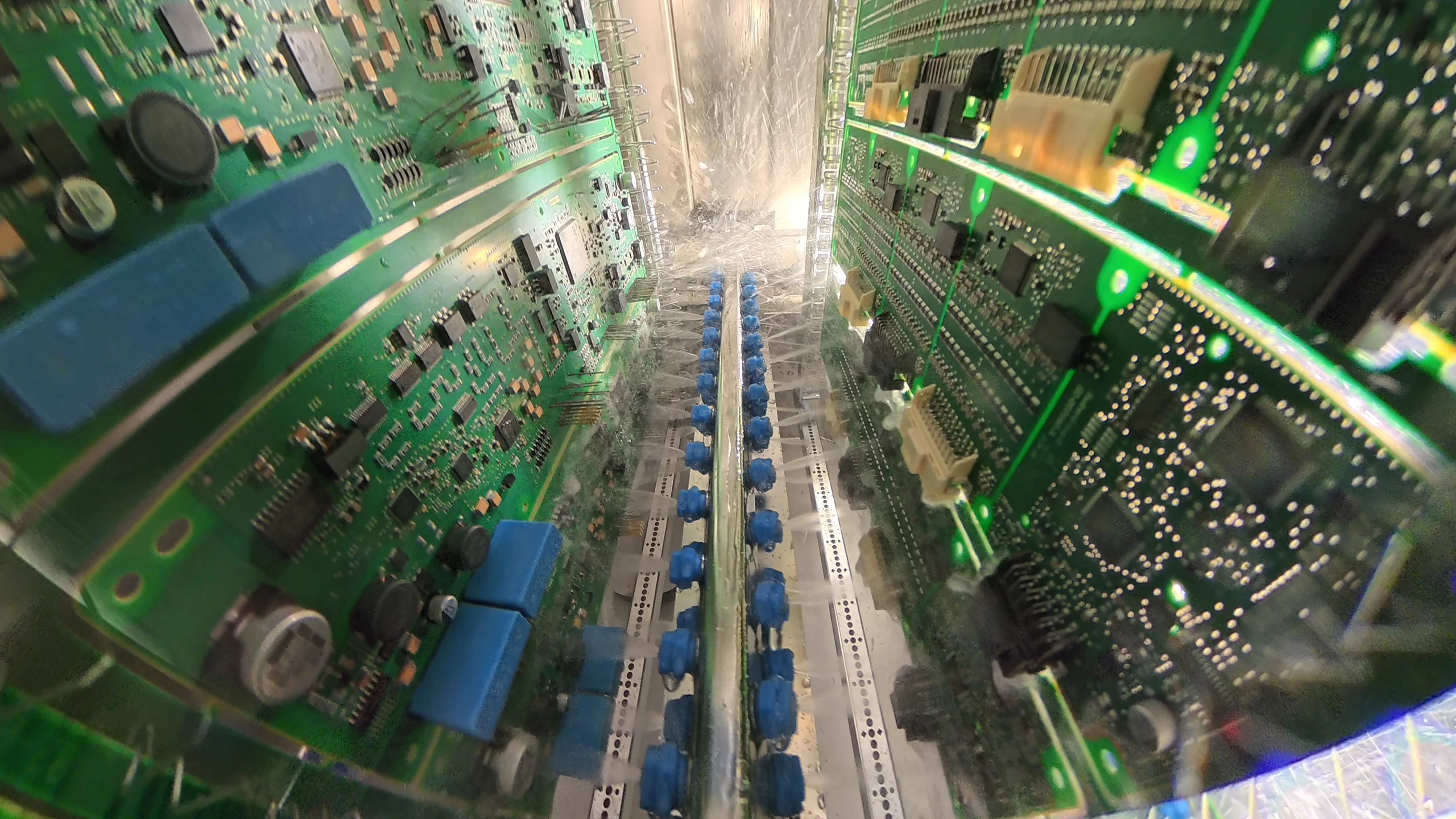
In spray-in-air systems, like PBTs cleaning machines, the assembly remains inside a process chamber while high-pressure nozzles spray cleaning chemistry directly onto the board surface.

Different nozzle geometries, spray angles, hydraulic pressures, and circulation systems are used to optimize cleaning performance and fluid penetration into small component gaps.

Why Spray-in-Air Is the Most Popular Cleaning Method

Spray-in-air cleaning currently represents the most widely used assembly cleaning method because it offers:

  • Strong cleaning performance
  • High process flexibility
  • Good penetration capability
  • Excellent balance between cleaning power and component safety
  • Suitability for modern SMT assemblies

Compared to immersion systems, spray-in-air cleaning delivers significantly higher kinetic energy to the contamination site, improving residue removal performance.

Ultrasonic Cleaning

How Ultrasonic Cleaning Works

Ultrasonic cleaning systems immerse assemblies in a cleaning bath while ultrasonic transducers generate high-frequency sound waves in the liquid.

These sound waves create microscopic cavitation bubbles that implode near contaminated surfaces. The resulting spot-pressure shock effects can effectively break down and remove stubborn flux residues.

Advantages of Ultrasonic Cleaning

  • Extremely high cleaning energy
  • Excellent residue removal capability
  • Effective cleaning in microscopic gaps
  • Strong performance for complex assemblies

Challenges of Ultrasonic Cleaning

While ultrasonic cleaning offers exceptional cleaning power, the high energy levels can potentially damage sensitive electronic components or assemblies.

Ultrasonic fields must therefore be carefully optimized for each specific board configuration to avoid unwanted resonance, oscillation interference, and thus component stress.

Comparing Cleaning Energy Between Cleaning Methods

The effectiveness of cleaning processes is strongly influenced by the kinetic energy delivered to the contamination site.

Approximate liquid velocities in different cleaning methods are:

  • Spray under immersion: ~1 m/sec
  • Spray in air: ~10 m/sec
  • Ultrasonic cleaning: ~1000 m/sec

Because kinetic energy increases proportionally to the square of velocity, ultrasonic cleaning transfers significantly more energy than spray-based methods. However, this also increases the importance of process optimization , which may be in some cases very challenging. and Component protection is a main concern.

Choosing the Right Cleaning Method for Electronic Assemblies

Selecting the optimal cleaning method depends on multiple factors, including:

  • Assembly complexity
  • Component sensitivity
  • Flux chemistry
  • Board density
  • Presence of Bottom-terminated components
  • Reliability requirements
  • Production volume
  • Environmental considerations

Modern electronics manufacturing increasingly demands customized cleaning solutions that combine cleaning chemistry, process control, nozzle design, and optimized fluid dynamics.

Need support with Electronic Assembly Cleaning?

Selecting the right cleaning method is essential for reliable electronics manufacturing. PBT Works helps manufacturers evaluate cleaning requirements, optimize cleaning processes, and choose suitable cleaning equipment for complex PCB and PCBA assemblies.

Cleaning Diagnostics 24

Cleaning Diagnostics

If you want to verify the effectiveness of your cleaning process, our Cleaning Diagnostics can help identify contamination risks and support process optimization.

Cleaning Diagnostics 24

FAQs: About Electronic Assembly Cleaning Methods

Electronic assemblies require cleaning to remove soldering flux residues, ionic contamination, oils, and particles that can cause corrosion, leakage currents, electrical failures, or reduced reliability.

Spray-in-air cleaning is currently the most widely used method because it provides strong cleaning performance while remaining suitable for sensitive SMT assemblies.

SMT components are mounted very close to the PCB surface, creating microscopic gaps where flux residues can become trapped. These tight spaces are difficult to access and clean effectively.

Spray under immersion cleaning submerges the assembly in cleaning liquid while submerged nozzles direct fluid toward contaminated areas to improve cleaning performance.

Spray-in-air cleaning offers strong cleaning power, good penetration into tight spaces, high flexibility, and compatibility with modern high-density electronic assemblies.

Ultrasonic cleaning uses high-frequency sound waves to generate cavitation bubbles in a cleaning liquid. The collapse of these bubbles removes contamination from surfaces and small gaps.

Yes. Improperly optimized ultrasonic cleaning can damage sensitive components due to high mechanical energy and resonance effects. Process optimization is essential.

Water-based cleaners are widely used because water is highly effective at binding ionic contamination while also offering improved fire safety and environmental compatibility.

Assembly cleaning removes:

  • Flux residues
  • Ionic contamination
  • Oils and greases
  • Dust and particles
  • Process residues
  • Fingerprints

Important factors include component sensitivity, assembly density, flux type, production volume, reliability requirements, and environmental regulations.

Facebook
LinkedIn
X
Get in touch with us to find the right cleaning solution for your application.

info@pbt-works.com
+420 572 153 111